
Lighting Guide & FAQ
Everything worth knowing about permanent lighting.
What it is, how it differs from seasonal lights, what it does for a property after dark, and the answers to the questions we get asked on almost every estimate.
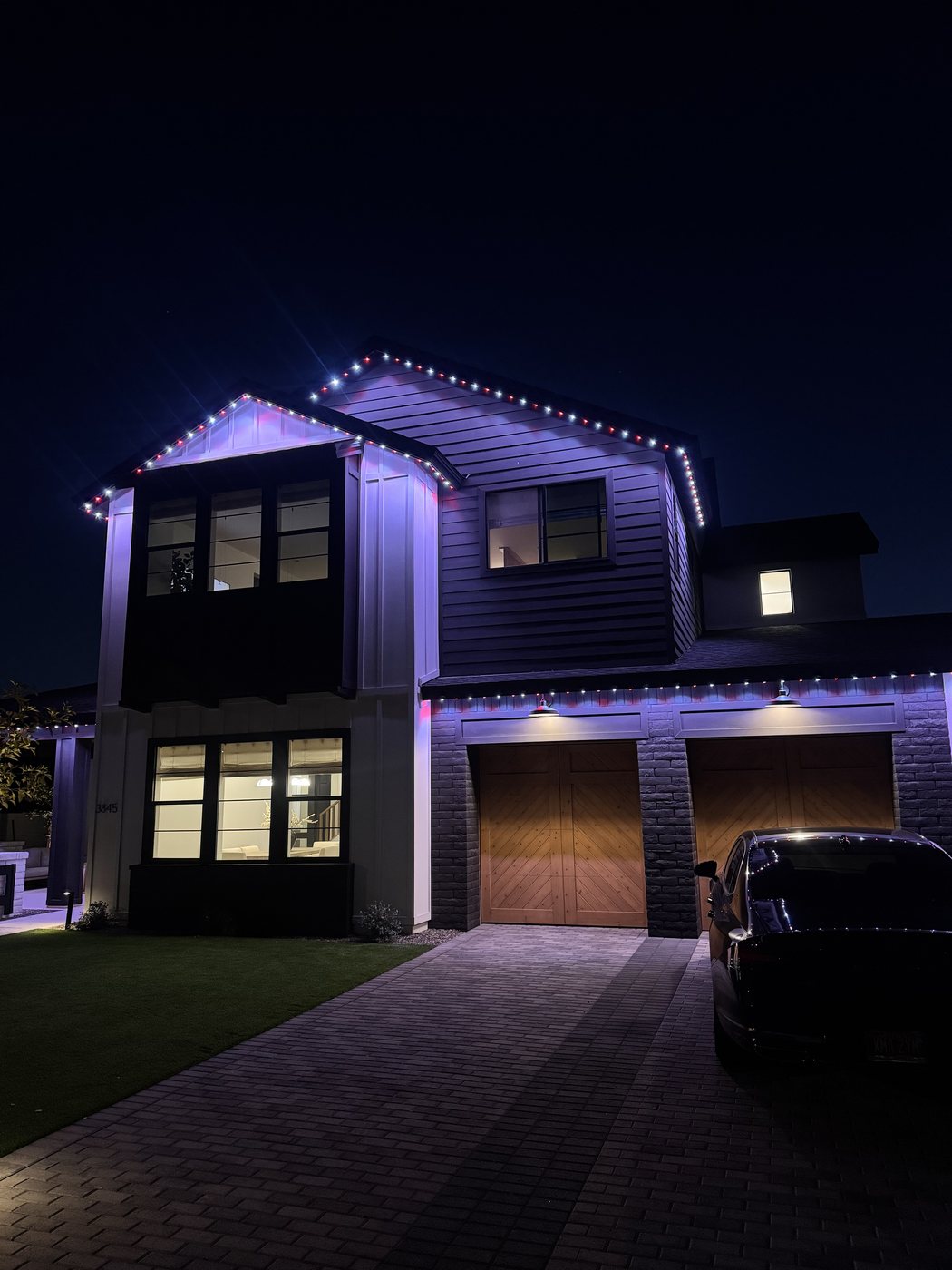
Permanent LED lighting is a track of individually addressable LED diodes installed discreetly into a building's eaves, soffits, or roofline and left in place year-round. Each diode can be set to its own color and brightness from a phone app, so a single system delivers security lighting, holiday lighting, and everyday accent lighting without ever being taken down.
It replaces three things at once: seasonal light rentals, dedicated security floods, and separate architectural accent fixtures.
The short version
- Installed once. No annual hanging, no takedown, no storage, no ladders.
- Invisible by day. The channel is color-matched to your trim and sits in the eave's shadow line.
- Three systems in one. Security, holiday, and everyday accent lighting from the same track.
- Controlled by app. Per-zone color, brightness, scenes, and dusk-to-dawn scheduling.
- Built to last. Low voltage, weatherproof, UV-resistant, and rated for roughly 50,000 hours.
Why It Matters
What exterior lighting does for a property
Most properties are designed to be looked at in daylight and then simply disappear at sunset. Exterior lighting is what keeps a building legible after dark — and the difference between a property that has been lit deliberately and one that has a porch bulb and a motion flood is not subtle.
It makes the architecture read after dark
A roofline picked out in warm light gives a building a defined shape at night instead of a dark mass against a dark sky. Gables, dormers, peaks, and columns become features. This is the effect people are reacting to when they say a lit house looks "finished" — the lighting is restating the architecture that daylight was doing for free.
It gives you back hours of usable space
Patios, pool decks, walkways, and yards that go dark at sunset are effectively unavailable for a large part of the year. Lighting them properly — not floodlighting them, but lighting them — turns them back into space you actually use. For most homeowners this is the change they notice first and value most.
It removes the dark pockets
Security lighting works by eliminating concealment, not by being blindingly bright. A single harsh flood creates as much deep shadow as it removes, and those shadows are exactly where someone can stand unseen. Even, full-perimeter coverage at moderate brightness does far more for actual safety than one aggressive light, and it does not blow out your camera footage or your neighbor's bedroom window.
It ends the annual ladder ritual
The hidden cost of seasonal lighting is not the strands — it is the labor, the risk, and the fact that it repeats forever. Falls from ladders during holiday decorating send thousands of people to emergency rooms every year. A permanent system moves that entire recurring task into a one-time professional install.
Side by Side
Permanent lighting vs. seasonal lights
| Permanent LED system | Seasonal string lights | |
|---|---|---|
| Install frequency | Once | Every year, twice (up and down) |
| Ladder work for you | None | Annual |
| Daytime appearance | Color-matched, effectively hidden | Visible strands and clips |
| Color changes | Any color, from the app | Fixed at purchase |
| Doubles as security lighting | Yes | No |
| Usable outside the holidays | Year-round | Weeks per year |
| Expected service life | ~50,000 hours | A few seasons |
| Recurring cost | None after install | Annual purchase or rental fee |
Questions
Frequently asked questions
The things people actually ask us on site. If yours is not here, call or text and ask it directly.
The Basics
What is permanent LED lighting?
Permanent LED lighting — also called permanent holiday lighting, architectural lighting, or year-round trim lighting — is a track of individually addressable LED diodes mounted discreetly into the eaves, soffits, or rooflines of a building. Unlike seasonal string lights, the track is installed once and stays in place permanently.
Each diode can be set to its own color and brightness, so the same system that runs warm white security lighting on a Tuesday can run red and green in December and a single accent color for a birthday. Everything is controlled from a phone app.
How is it different from regular Christmas lights?
Regular holiday lights are temporary. Someone climbs a ladder every November to hang them and again every January to take them down, the strands degrade in storage, and the whole cost repeats annually — either in your own time or in rental fees.
Permanent lighting inverts that. The install happens once. The track is color-matched to your trim so it disappears in daylight, it runs on low voltage, and switching from holiday mode to everyday warm white is a tap on your phone rather than a weekend on a ladder.
Can I see the track during the day?
Barely, and that is the point. The channel is color-matched to your fascia, trim, or gutter and tucked into the shadow line under the eave. From the street in daylight most people cannot pick it out at all — it reads as part of the roof edge.
Is it actually permanent, or does it need replacing?
The diodes themselves are rated for roughly 50,000 hours of use. Run a few hours a night, that works out to a service life measured in decades rather than seasons. The track, connectors, and power supplies are sealed and rated for outdoor exposure.
Design and Appearance
How does exterior lighting actually improve a property?
Exterior lighting does four distinct jobs, and a well-designed system does all of them at once:
- It defines the architecture. A roofline picked out in warm light reads as a deliberate shape after dark instead of a dark mass against a dark sky. Gables, dormers, and peaks become features rather than silhouettes.
- It extends usable hours. Patios, pool decks, and walkways that go unused after sunset become usable space again. For most homeowners this is the change they notice first.
- It removes hiding places. Even, full-perimeter light eliminates the dark pockets along side yards and behind landscaping where someone could stand unseen.
- It signals occupancy. A consistently lit property reads as attended to, which matters both for deterrence and for how the place presents to neighbors and visitors.
What is the difference between accent, wash, and security lighting?
Accent lighting picks out a specific feature — a gable peak, a stone column, a specimen tree — with a narrow, directional beam. It creates contrast and depth.
Wash lighting spreads even light across a broad surface like a wall or a facade. It flattens texture but makes the whole plane read as one shape.
Security lighting prioritizes coverage and evenness over drama. The goal is no dark gaps anywhere along the perimeter, at a brightness that does not blow out a camera or annoy a neighbor.
A permanent system can do all three from the same track, which is why one install replaces what used to take three separate lighting products.
What color temperature should exterior lighting be?
For everyday use on a residence, warm white in the 2700K to 3000K range is almost always the right answer. It flatters brick, stone, stucco, and wood, and it reads as welcoming rather than institutional.
Cooler temperatures — 4000K and up — read as clinical on a home but are genuinely useful for working areas: barns, equipment yards, and loading zones, where the priority is seeing detail rather than looking inviting. A permanent system lets you run warm on the house and cool on the outbuilding from the same controller.
Will it be too bright or bother my neighbors?
Brightness is adjustable per zone and per diode, and most installs run far below full output for everyday use. The track is also aimed downward and shielded by the eave, so light lands on your property rather than spilling sideways into someone else's windows. If a particular run turns out to be brighter than you want, it is a settings change, not a re-install.
Installation
How long does an install take?
Most residential installs are finished in a single day. Larger properties, commercial buildings, and agricultural sites with multiple structures can run two to three days. We map the full run before we touch a wire, so the timeline we quote is the timeline you get.
Is it safe? What kind of power does it use?
The system runs on low voltage. That is a meaningful safety difference from line-voltage exterior lighting: there is no shock hazard at the track itself, and the wiring can be run in places line voltage cannot. Transformers are mounted in a serviceable location and the whole run is sealed against moisture.
Will it damage my roof, gutters, or siding?
No. The channel mounts to the fascia or into the soffit line using fasteners sized for the substrate, and we do not penetrate the roof membrane or the gutter interior. We map every install in advance specifically so we know where the mounting points fall before anything gets drilled.
What happens on install day?
The crew arrives at the scheduled time, confirms the mapped run with you, mounts the track, runs and seals the wiring, sets the transformer and controller, and tests every zone. Before we leave we set the app up on your phone, walk you through each mode, and clean the site. You should not be finding fasteners in your landscaping afterward.
Control and Modes
How do I control the lights?
Through a phone app. You can set colors and patterns per zone, dim or brighten any run, build and save your own scenes, and put the whole system on a schedule so it comes on at dusk and off at a set hour without you touching anything.
Can different parts of the property do different things at once?
Yes. The diodes are individually addressable, so the front elevation can run warm white while the back patio runs a color scene and the side yard runs at security brightness. Zones are defined during the install and can be regrouped later in the app.
What happens if the internet or power goes out?
Scheduling and saved scenes live on the controller, not in the cloud, so the system keeps running its schedule if your internet drops — you just lose the ability to change it from the app until the connection returns. After a power outage the controller restores its last state automatically.
Cost, Durability, and Support
What does permanent LED lighting cost?
Cost depends on linear footage, the number of zones, roof access, and how many structures are involved, so we do not publish a flat number that would be wrong for most properties. What we do is walk the property, map the actual run, and send a fixed-price quote within 24 hours of the visit. The price we quote is the price you pay.
The useful comparison is against what you already spend: professional seasonal install and takedown is an annual recurring cost, and a permanent system typically pays for itself against that over a handful of seasons while also covering security and everyday lighting.
How much does it cost to run?
Very little. LEDs draw a fraction of what incandescent holiday lights pull, and most everyday scenes run well below full brightness. Running a typical residential roofline nightly costs on the order of a few dollars a month.
Does weather affect it?
The track, connectors, and power supplies are weatherproof and UV-resistant, rated for sustained outdoor exposure including sun, wind, rain, snow load, and freeze-thaw cycling. UV resistance matters more than people expect — it is what keeps the channel from yellowing and going brittle after a few seasons of direct sun.
What kind of warranty and support do you offer?
Every install carries a 90-day workmanship warranty: if something from our install goes wrong in that window, we come back and fix it at no charge. Beyond that, you can call or text us any time — we answer 24/7, because lighting problems do not keep business hours.
Do you work on commercial and agricultural properties?
Yes. Alongside residential work we install on commercial buildings, barns, equipment yards, and working agricultural sites. Those jobs weight differently — coverage, operating hours, and worker safety matter more than holiday color — but the underlying system is the same.
Still Have Questions?
Ask us directly.
We answer the phone 24/7, and the on-site walk is free whether or not you book the job.